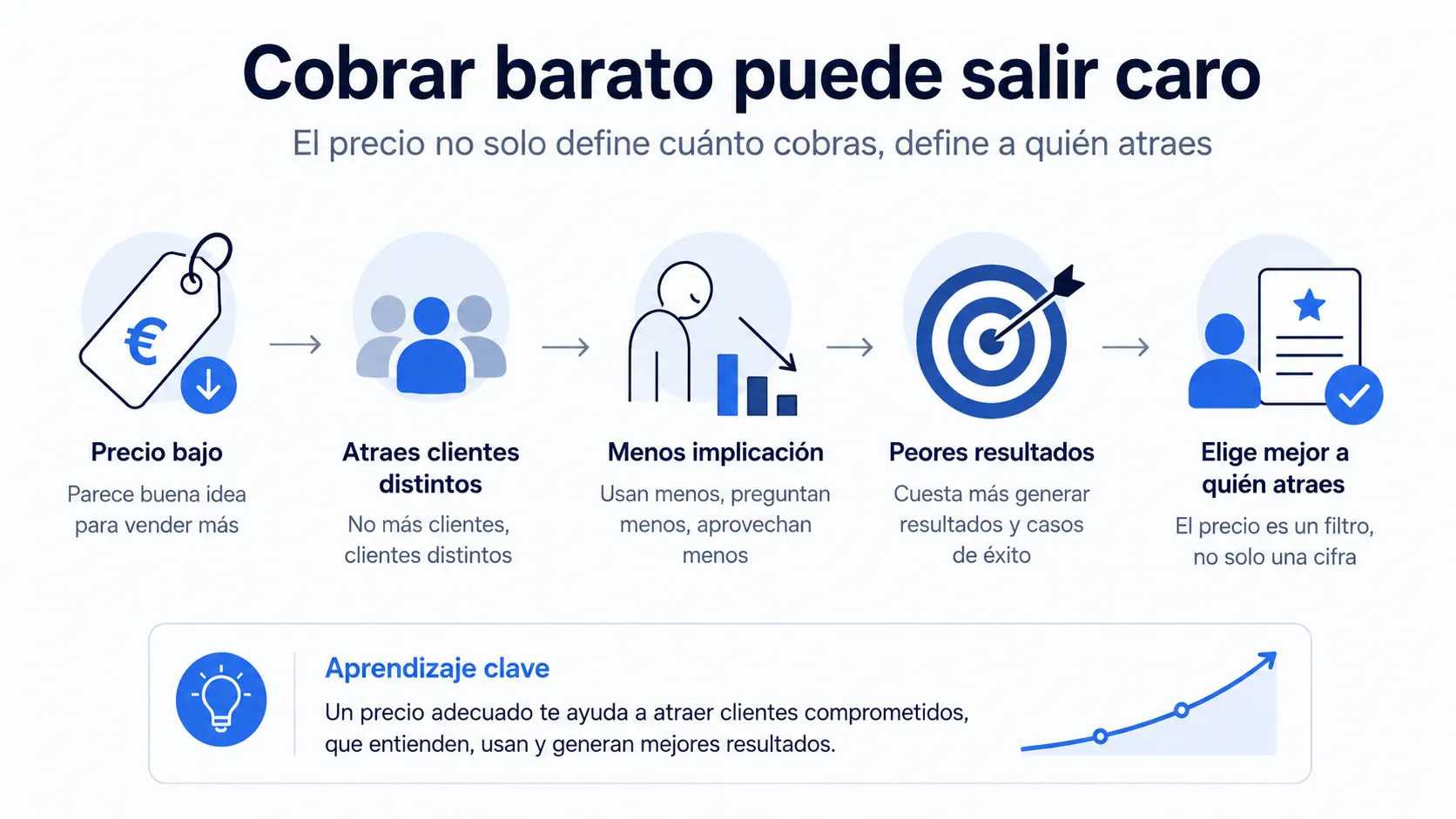

Why Setting Low Prices Seems Like a Good Idea When You Are Starting Out
Charging low prices when you are starting out often seems like a fairly logical decision, especially if you do not have much experience yet, if you feel uncomfortable setting a higher price, and if you think it will attract more people. The idea behind it is quite simple: if the price goes down, the barrier to entry also goes down, so it should be easier to sell. That is why many people see it as the obvious choice at first, even though in practice it may not work as they expected.
The problem is that this logic, although it makes sense on paper, mixes up two things that are not the same: selling more and attracting better customers. And that is usually where the mistake lies. Lowering the price does not always make your product easier to sell in the way that matters to you, which is attracting customers who understand what they are buying, use it properly, and genuinely value it. If you do not separate those two layers, you may think you are making it easier for people to come in when you are actually changing the type of customer who comes in.
What Really Changes When You Charge Too Little
When you charge too little, it is not just the number shown in the offer that changes. The customer's relationship with what you are selling also changes. If they pay little, they often perceive little value as well, even if the product is good. And that means they come in with less attention, less intention to understand it, and less commitment to the outcome.
Moreover, the underlying fear is usually something else: not so much charging more, but feeling that you do not yet have enough experience to justify it. That is quite common when starting a business. But not wanting to overcharge is one thing, while positioning yourself so low that you end up attracting people who are not the best fit for you is something very different. At that point, price stops being a tool for positioning yourself and becomes a filter that works against you.
You Do Not Attract More Customers, You Attract Different Customers
This point is key because it corrects an idea that is often repeated when starting out. Charging less does not mean you will automatically attract more customers. What usually happens instead is that you attract different customers. And that difference matters much more than it may seem because it shapes how they buy, how they use the product, and what they expect from you afterward.
That is why the analysis should not stop at whether more or fewer people come in. It should focus on who comes in and how well they fit. If your price attracts people who buy on impulse, who do not fully understand what is in front of them, or who are not very willing to get involved, the problem is not only commercial. It is also operational because everything becomes harder afterward: explaining, supporting, activating, and achieving results.
When the Price Goes Down, Engagement Can Go Down Too
When the price drops significantly, customer engagement can also decline. Not always, but quite often. And it quickly becomes noticeable: they use it less, ask less useful questions, postpone things more, and get less out of what they bought. Not because the product has become worse, but because their initial level of commitment was already lower.
That has a fairly important consequence, especially for a young business: it becomes harder to generate strong, visible results. And if generating results is harder, building success stories is also harder. Ultimately, a real customer case does not come solely from having something good to offer; it also requires the other party to be involved enough to get value from what they bought.
The Problem Is Not Charging More, but Selling to a Different Segment
It is worth changing the perspective here because people often think that raising prices means trying to sell the same thing to the same person, only at a higher price. But that is not what it is about. What really changes is the segment you target. In other words, you are not forcing the same customer to pay more; you are directing your offer toward another type of customer who is a good fit for that price point.
That also helps ease a lot of the fear. The debate stops being about whether fewer people will buy from you if you raise the price and becomes about whether you are speaking to the right profile for that offer. When you see it that way, price stops looking like a risk in itself and starts working as a way to better define whom you want to attract and whom you want to work with.
A Higher Price Point Changes the Type of Customer Who Can Come In
A higher price point does not necessarily mean that something is expensive in a negative sense. If it is worth it, it is simply at a different level of access. And that means different people come in, with a different mindset and a different way of evaluating the purchase. It is not about setting a higher figure for no reason, but about understanding that each price range opens the door to some profiles and closes it to others.
That is why, when you raise the price point, it is not only the potential revenue that changes. The type of conversation you have with the customer, the level of attention they pay, and the likelihood that they genuinely want to make the most of what they are buying also change. That nuance is important because the mistake often lies not in the price itself, but in thinking that all customers respond the same way to any price.
Why More Committed Customers Generate Better Results
Customers who pay more usually also make a greater effort to understand the product and get value from it. Not because paying more makes them better by definition, but because they come in with a different intention from the outset. They have made a more deliberate decision, assessed what they are buying more carefully, and therefore tend to become more involved in the process.
And that involvement greatly improves the final outcome. It makes it easier for them to use the product properly, remain consistent, and produce clear insights into what works and what does not. From there, it is much more likely that you will build solid results, and those results can then help you strengthen the business, refine the offer, and develop a real customer case that is genuinely meaningful, rather than merely closing a sale that goes nowhere.
What This Real Customer Case Teaches Us
If there is one clear idea to take away from all this, it is this: charging low prices does not always help you sell more, and sometimes it directly makes growth more difficult. First, because it changes the type of customer you attract. Then, because that type of customer may be less engaged. From there, everything else suffers: usage, results, and the ability to build success stories.
So the lesson from this real customer case is not so much about setting high prices for the sake of it, but about understanding what type of customer you want to attract and what kind of relationship you want them to have with your product. If you define that properly, price stops being just a number and becomes a fairly important part of the strategy. That is when it stops looking like a barrier and starts working as a useful filter.
👉 How much does it cost you to acquire each new customer? Using six data points from a typical month, calculate your CAC, how many months it takes to recover it, and your LTV/CAC ratio. Calculate our CAC